Best Time for a Tunisia Sahara Tour
When to take a desert tour in Tunisia — month-by-month temperatures for Tozeur and Douz, how cold the camps get at night, and which months operators shorten their desert legs.
The Tunisian Sahara has a season, and it is the opposite of the beach season. The months that fill the resorts at Hammamet and Sousse are the months when a desert day is genuinely unpleasant, and the months when the coast is quiet are when the south is at its best. If your dates are flexible, this is the single decision that most affects how much you enjoy a desert tour.
Check Availability
The short answer: October to April
The desert season runs from roughly October to April, and inside it the sweet spots are late October to early December and March to April. Days are warm without being punishing, the light is long, and the camps are comfortable at night without being cold enough to spoil the evening.
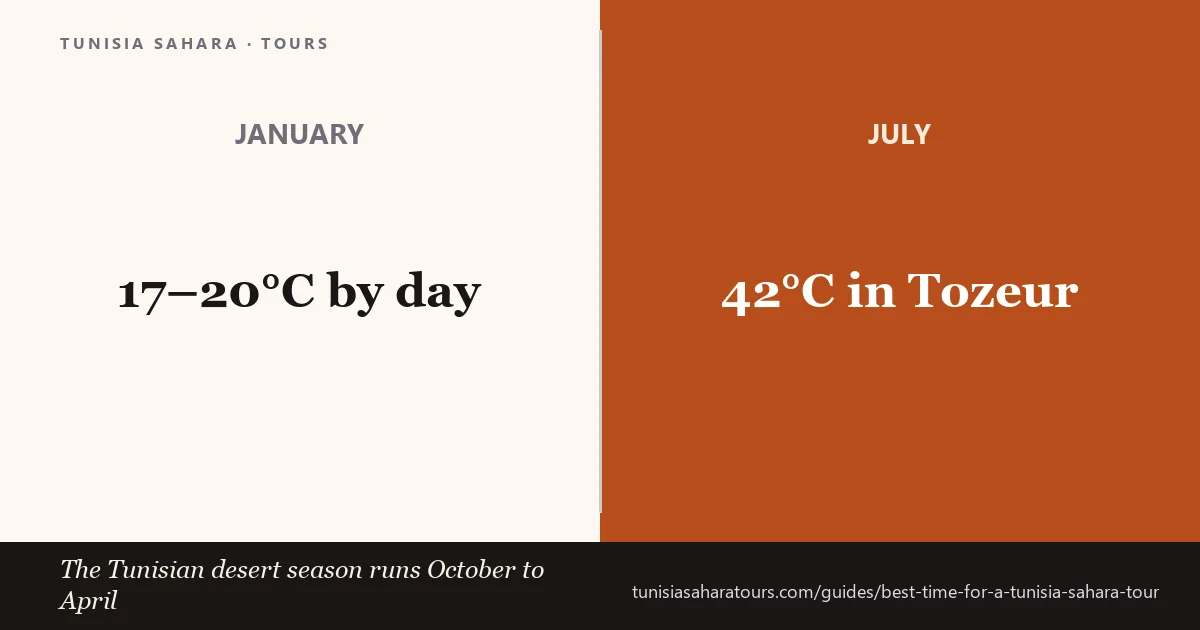
January is the coldest month and also one of the clearest: Tozeur sits around 17–20°C by day with nights close to freezing. That is excellent walking weather for the ksour and the canyons, and it means a real fleece at the camp rather than a light jacket.
What summer actually does
July and August are the reason this guide exists. Tozeur reaches around 42°C in July, with nights near 28°C, and August regularly passes 45°C in both Tozeur and Douz. Douz sits a little lower in July, around 40°C, with nights near 24°C.
Those numbers are shade temperatures. The sand is hotter, the ksour have no shade at all, and Mos Espa — an open site with nothing on it but ruined set pieces — is a genuinely hard place to stand at noon in August.
If your trip falls in high summer, the desert is still worth doing, but choose differently: take a tour that puts the dunes at sunset or sunrise rather than midday, favour the overnight and camp itineraries over long day trips, and expect some operators to shorten or reschedule their desert legs.
Month by month
October. The season opens. Days in the high twenties, nights mild, the light already long. One of the two best months.
November and December. Cooling steadily. Camp nights start needing a proper layer. Douz fills at the very end of December for the International Festival of the Sahara — four days of camel marathons, horse fantasias and sloughi racing, usually somewhere between the 23rd and the 29th, with dates often confirmed under a month ahead.
January and February. The coldest and often the clearest. Tozeur days 17–20°C, nights close to zero. Bring a fleece, long trousers and socks for the camps — the blankets are real but the tents are not heated.
March and April. The other sweet spot. Warming days, comfortable nights, and the desert at its greenest after the winter rain, which is a brief and surprising thing to see.
May. Still good in the first half, hot by the end. The last comfortable month for a long day trip.
June to September. Hot to extreme. September improves markedly towards its end.
What the temperature changes about the tour
Three things, and they are worth planning around rather than enduring.
Pickup times. Northern two-day tours leave around 5am in every season, partly to reach El Jem before the heat. In summer that matters more, not less.
The hot spring. Ksar Ghilane’s spring-fed pool is warm year round, which is delightful in January and slightly beside the point in July.
The night. From November to March desert nights drop close to freezing however warm the afternoon was. This is the single most common piece of unpreparedness on these tours. The camps provide blankets; they do not provide clothes.
Frequently asked questions
What is the best month for a Sahara tour in Tunisia?
October and April are the two best, with March and late November close behind. All four give warm days, comfortable nights and long light without the extremes at either end of the year.
Is it too hot for a desert tour in July and August?
Tozeur runs around 42°C in July and past 45°C in August, so a midday day trip is hard work. The tours still run. Choose an itinerary built around sunset and sunrise, and favour an overnight camp over a long day in a vehicle.
How cold is the Tunisian desert at night in winter?
Close to freezing from November to March. Tozeur’s January nights sit near zero while its days reach 17–20°C — a swing of nearly twenty degrees in twelve hours.
Does it rain in the Tunisian Sahara?
Rarely, but it happens, usually in winter and usually briefly. Several operators state that their desert legs may be adjusted or cancelled in bad weather, with a full refund — which is one more reason to book something with free cancellation.
Is the Sahara busy in high season?
The Ksar Ghilane pool has people in it between October and April, and Douz fills for the December festival. Fifty metres from the last tent there is still nothing but sand, and most reviews that mention crowds still rate the stop highly.
When do the desert camps close?
Most run year round, but the offering thins in July and August when demand drops. If you are travelling in high summer, book earlier rather than later — there are fewer departures, not more.
Ready to pick a month and a route? Start with the decision guide or browse every Sahara tour with live prices.
See the Sahara From Your Hotel Door
Hotel pickup, a 4x4 across the Dahar plateau, the hot spring at Ksar Ghilane, and lunch — rated 4.8/5 by 1,671 guests. Free cancellation up to 24 hours before.
Check Availability & Book