Chott el Jerid Tunisia Guide
How to cross Chott el Jerid, Tunisia's great salt pan, between Tozeur and Douz: where to stop, when the light and mirages are best, the Star Wars dome near Nefta, and the tours that drive it.
Chott el Jerid is the salt pan you cross between Tozeur and Douz: about an hour of straight, raised road with white crust to the horizon on both sides. You do not need a separate trip for it. Put it on the Tozeur–Douz leg, cross it early in the morning or late in the afternoon, and stop once to walk a few steps onto the salt.
Check Availability
Quick take
Chott el Jerid works best as part of a route through the south, not as a destination of its own. The crossing links the oasis country around Tozeur with the dunes at Douz, so the trips that work best use it once, in good light, on the way from one base to the other. Leave time at each end for a sunset, a proper meal and at least one unhurried stop.
Key planning points
- What Chott el Jerid is. The largest salt pan in the Sahara, between Tozeur and Kebili.
- What the landscape looks like. Flat white and rust-coloured crust, dry for most of the year, with a thin sheet of water after winter rain.
- Where and how long to stop. One stop on the causeway is enough for most people.
- Why it belongs on the Tozeur–Douz route. The road across it is the direct way between the two bases, about 122km and two hours in all.
- Star Wars connections. The Lars homestead dome stands on the salt-pan edge near Nefta.
- Why you should not improvise off-road driving. The crust can be soft under a dry surface; stay on the tarmac.
1. What Chott el Jerid is
Chott el Jerid is a seasonal salt lake in south-western Tunisia, lying between Tozeur on its north-western shore and Kebili to the east. It is the largest salt pan in the Sahara. Wikipedia’s entry gives an area of about 7,000km² and a length of some 250km, though published figures range from 5,000 to 10,000km² because the area under water changes from year to year. Small streams feed it in winter; by summer the heat has evaporated almost all of it.
On any route between the Tozeur oases and the Douz dunes, you cross it. A raised road runs over the pan from the Kebili side to Tozeur, and the open salt crust lies on both sides of the road for most of the drive.
What to check: whether your tour crosses the chott on the way somewhere or drives out and back from Tozeur, and what time of day it reaches the causeway.
2. What the landscape looks like
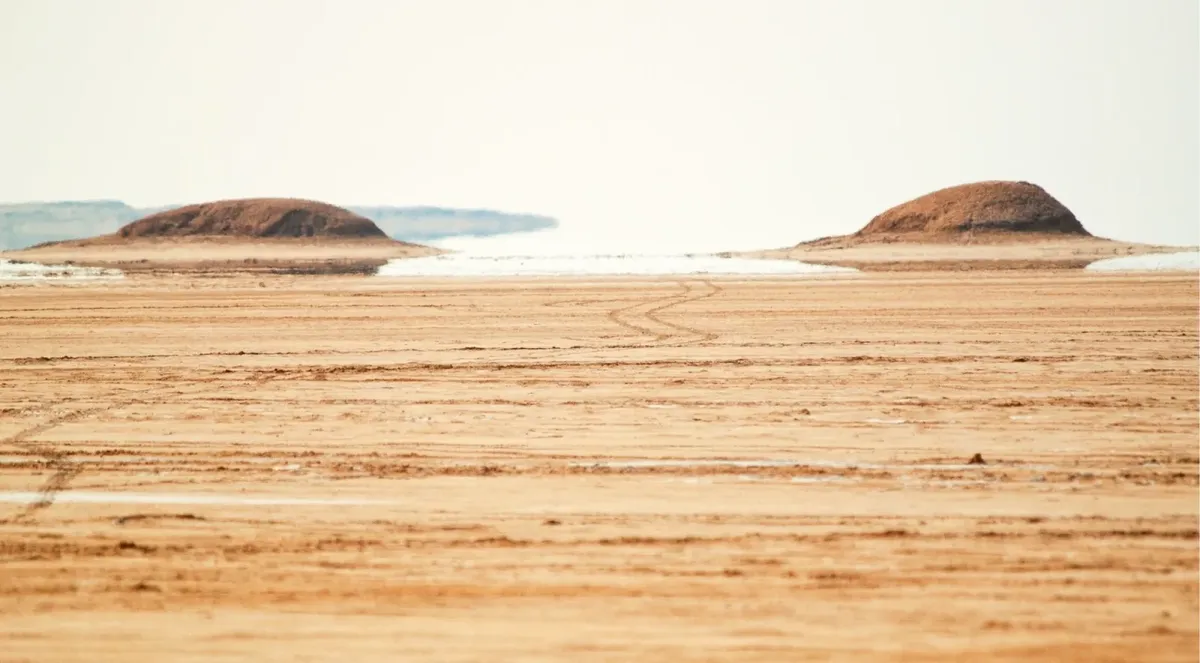
For most of the year you see a flat, hard crust, white in places and rust-coloured or grey in others, with no trees, no buildings and, by mid-morning, no clear horizon. As the ground heats up, mirages appear above the salt: the far edge seems to float, and the road ahead looks wet. These mirages are strongest in the heat of summer, but you can see them on a warm spring or autumn day too.
After winter rain, a thin sheet of water can lie on the surface and reflect the sky, and parts of the pan can turn greenish or purple. You cannot plan for that, and it can be gone within weeks. In the low light of early morning or late afternoon the crust shows its texture and colour. At midday it turns flat and washed out, and the glare off the salt is hard on the eyes.
What to check: what time your crossing is scheduled, and whether you have sunglasses within reach, not packed in the boot.
3. Where and how long to stop
Most tours make one photo stop on the causeway, at the roadside stalls where vendors sell salt-crystal “desert roses” and drinks. That stop is enough for most people: twenty minutes lets you walk a few metres onto the hard crust near the road, take photographs in both directions and buy a desert rose if you want one.
Do not walk far out onto the salt. Away from the road the crust can be soft and wet underneath, and in the heat of the day there is no shade anywhere on the pan. If you are driving yourself, park only where other vehicles already stop and keep your wheels on the hard shoulder.
What to check: whether the tour includes a stop on the chott at all (some coach routes drive straight across), and whether the stop falls in the morning or late afternoon.
4. Why it belongs on the Tozeur–Douz route
From Douz the road runs north-west through Kebili and then onto the causeway; from the far shore it is a short drive into Tozeur. The full drive is about 122km and roughly two hours, and the crossing itself takes about an hour. Our Tozeur desert guide and Douz Sahara guide cover the bases at each end.
The time of day matters on this stretch. If you sleep in a desert camp near Douz and drive to Tozeur the next morning, you cross the salt in the early light, before the heat haze builds. If the crossing leads on to a desert night near Douz, check the exact camp location, the bathroom setup, the bedding, which meals are included and how you get from the road to the camp; our overnight camping guide goes through each. For activities at the Douz end, choose the one you want, whether a camel, a quad or a 4x4. Booking all three for the same hour leaves you rushing each one.
From the northern coast, the 2-day mountain oases and Sahara desert camp tour ($148, rated 4.8 from 141 reviews) does exactly that: a camp night in the dunes, then the chott crossing after breakfast on day two, followed by Chebika. From Djerba, the two-day tour to Tozeur, the mountain oasis and Matmata ($150, 4.8 from 25 reviews) crosses the chott on the first morning on the way to the mountain oases, and the 2-day tour of Tozeur and the mountain oasis ($197, 4.9 from 13 reviews) runs a similar route with a guesthouse lunch. Take the $148 tour if you start in Tunis, Hammamet or Sousse; take the $150 Djerba tour if you are staying on the island and want Tozeur and the oases as well as the salt.
What to check: which direction your route crosses in, and whether it puts the crossing in the morning or the afternoon.
5. Star Wars connections
The film link here is the Lars homestead dome, the white igloo-shaped exterior of Luke Skywalker’s home. It stands on the edge of the salt pan near Nefta, west of Tozeur. The interior scenes were shot at Hotel Sidi Driss in Matmata, about 300km to the east, so the two halves of the same fictional house are a long day’s drive apart. The dome is a restored shell, not a set you can go inside; it takes ten minutes to photograph.
The larger film site in this corner of Tunisia is the Mos Espa town set, built for The Phantom Menace in 1997 and still standing among the dunes near Ong Jemel, about 40km from Tozeur. Tours from Tozeur reach it through Nefta, and some cross the smaller salt pan of Chott el Gharsa on the way. Matmata’s troglodyte houses belong to the other Star Wars cluster, on the Douz–Gabès side; see our Star Wars filming locations guide and Mos Espa tours page for both. On Viator, the half-day Ong Jemel and Mos Espa excursion from Tozeur (4.4 from 9 reviews) is the dedicated option, with few reviews so far.
What to check: whether a “Star Wars” tour from Tozeur includes the Lars dome near Nefta or only Mos Espa, since many stop at the set alone.
6. Why you should not improvise off-road driving
The causeway is tarmac, and an ordinary hire car manages the crossing without trouble. The danger starts when you leave the road. The crust looks hard and dry, but in places the ground underneath is soft and wet, and a car that breaks through can sink to the axles a few metres from the tarmac. Help can be a long way off, there is no shade, and hire contracts usually exclude off-road damage.
Keep to the road and the established stopping places. If you want to go out onto the salt or the dunes beyond it, go with a local driver in a 4x4 who knows which ground holds.
What to check: your hire contract’s off-road clause, a full tank before you leave Tozeur or Kebili, and enough water in the car for the whole drive.
How long do you need?
The crossing itself is about an hour of driving plus one stop, so plan your days around the places at each end. Two days is enough for an overnight introduction that includes the chott, a camp night near Douz and the oases around Tozeur. Three days is better for a first route that gives Tozeur and Douz a night each. From Djerba, one day works for Ksar Ghilane, but Tozeur and the chott are too far for a comfortable day trip.
Best time to go
October through April is the easiest season for the crossing and for everything at either end of it, with November and March especially comfortable for a mix of sightseeing, camping and outdoor activities. Winter is when water is most likely to lie on the salt after rain. In July and August, 42°C is a normal Tozeur afternoon, the mirages are at their strongest and stepping out of the car at midday is hard work, so cross at first light. Our guide to the best time to visit the Tunisian Sahara goes month by month.
Self-drive or organised tour?
The road from Tozeur to Kebili and Douz is paved all the way, and this is one of the easiest drives in the south to do yourself. Genuine dune tracks and remote camps should be left to suitable vehicles and local drivers who know them.
For a short two- or three-day trip, an organised route is often more efficient, because the driver handles the long legs from the coast and times the crossing for you. Self-driving becomes more attractive when you have four or more days and want to control photography stops, meal times and nights in different bases; with your own car, you can stop on the chott at sunrise when no tour bus is there.
What to pack
- Comfortable closed shoes for walking onto the crust
- Lightweight trousers and breathable tops
- Hat, sunglasses and sunscreen (the glare off the salt is strong)
- Scarf for wind and sand
- Water bottle
- Power bank
- Warm layer for desert evenings
- Small overnight bag if camping
- Swimwear and towel if your route also takes in Ksar Ghilane
Frequently asked questions
Is Chott el Jerid worth adding to a first Tunisia Sahara trip?
Yes, if your route links Tozeur and Douz, because you cross it anyway; plan the crossing for early morning or late afternoon. It is not worth a detour on its own. The main mistake is trying to include every famous southern destination in too little time.
How many days should I allow?
The crossing takes about an hour. Allow two days for an overnight introduction that includes it, and three or more for a circuit with a night each in Tozeur and Douz.
Do I need a 4x4 to cross Chott el Jerid?
No. The causeway between Kebili and Tozeur is paved and any car can drive it. Use local 4x4 transport only for desert tracks, remote camps and off-road excursions, and never drive onto the salt crust itself.
Is one desert night enough?
For most first-time visitors, yes. One night gives you sunset, darkness and sunrise, which are the main reasons to stay. A camp night near Douz also puts the chott crossing in the morning light on the drive to Tozeur.
What is the best season for Chott el Jerid?
October through April is generally the most comfortable period for the crossing and for outdoor Sahara activities. Winter rain can leave a sheet of water on the salt; summer brings the strongest mirages and the hardest heat.
Final planning advice
Plan the itinerary for the experience you care about most. If that is dunes and camping, protect the evening in the desert near Douz and cross the chott the next morning. If it is oases and Star Wars, give Tozeur two nights, with time for the mountain oases at Chebika, Tamerza and Midès and the sets near Nefta. If it is convenience, choose Ksar Ghilane from Djerba instead of forcing a cross-country route. A slightly shorter list of stops usually makes a better Sahara trip.
Ready to book? Compare Tozeur desert tours and Douz desert tours with live prices, or use the decision guide to compare every route on the site.
See the Sahara From Your Hotel Door
Hotel pickup, a 4x4 across the Dahar plateau, the hot spring at Ksar Ghilane, and lunch — rated 4.8/5 by 1,834 guests. Free cancellation up to 24 hours before.
Check Availability & Book