Douz Sahara Guide: Desert Tours, Camps & Best Things to Do
How to use Douz, the town where the Grand Erg Oriental begins: sunset camel rides, camp nights at Zaafrane and Sabria, deeper 4x4 trips towards Tembaine and the drive across Chott el Jerid to Tozeur.
Douz is the one town in Tunisia where the dunes start at the end of the last street, so it is the place to stay if sand is the point of your trip. Give it one night at least: arrive by mid-afternoon, ride out for sunset, sleep in a camp or a town hotel, and cross Chott el Jerid to Tozeur the next morning.
Check Availability
Quick take
Come to Douz for the Grand Erg Oriental, the sand sea that begins at the town’s edge. You do not need a transfer to reach the dunes, so the shortest outing here is a three-hour sunset ride, and a camp night costs you less time on the road than anywhere else in the country. Many visitors pass through on the second day of a coach tour from the north and see the dunes for an hour. One free night in Douz gives you the sunset, the dark and the sunrise those tours rush past.
Key planning points
- Why Douz is a Sahara gateway. The erg starts where the town stops, with no drive to the sand.
- Sunset camel rides. Leave between about 3:30pm and 4:30pm; midday rides get flat light and heat.
- Sabria and Zaafrane camp options. Zaafrane is a short drive from town; Sabria sits farther out in the sand.
- Tembaine and deeper 4x4 travel. A long day or more off-road, arranged locally; no GetYourGuide or Viator listing goes there.
- Chott el Jerid and the route to Tozeur. About two hours (122km) on a paved road across the salt pan.
- How long to stay in Douz. One night for the dunes, two if you want a full day out in the erg.
1. Why Douz is a Sahara gateway
Douz sits on the northern edge of the Grand Erg Oriental. From most hotels you can walk into the sand. Everywhere else in southern Tunisia the dunes are a drive away: Tozeur is about two hours by road and Ksar Ghilane about 145km on paved road, so travellers based there spend part of every desert outing in a vehicle.
The town is a working oasis with a large palm grove, a small Museum of the Sahara and a weekly market. At the end of December it hosts the International Festival of the Sahara, usually four days somewhere between the 23rd and the 29th, with camel races, horse fantasias and sloughi racing at the edge of the dunes. The dates are often confirmed less than a month ahead, so check them before you book a December trip, whether you want the crowds or want to avoid them.
What to check: if a tour from the coast includes a night “in Douz”, find out whether it is a town hotel or a camp out in the sand. A hotel means you see the dunes at one stop; a camp means you wake up in them.
2. Sunset camel rides
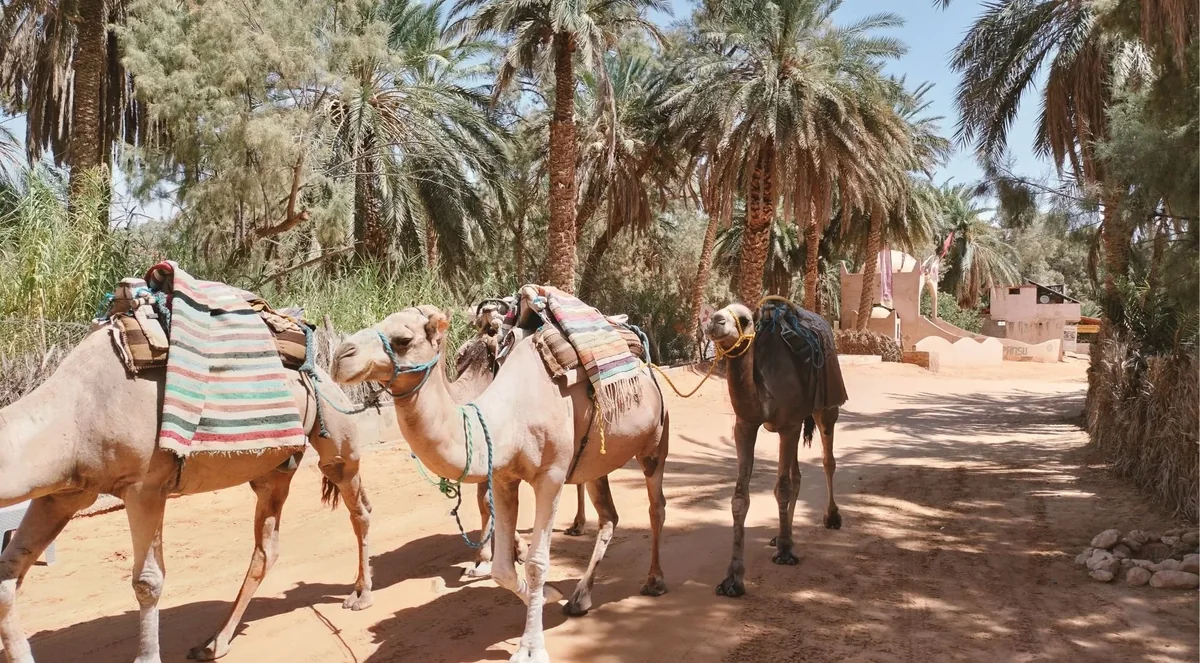
Timing matters more than the operator. The dunes look flat and washed out at midday and turn gold and shadowed in the last hour before sunset, so the Douz rides leave in the afternoon: pickups run from about 3:30pm to 4:30pm on the listings below. Choose one ride and give it the whole evening; a camel ride, a quad session and a 4x4 run crammed into the same hour gives you none of them properly.
There are two ways to do it.
- Out and back the same evening. On Viator, the sunset or sunrise camel ride from Douz ($65, 4.7 from 10 reviews) is a three-hour private outing with hotel pickup in Douz and a climb to the top of a dune for the view. Ten reviews is a small sample, so read them before you book.
- Ride out, sleep, ride back at sunrise. The overnight camp with dinner, sunset and sunrise by camel ($116, 4.5 from 73 reviews) has more reviews than any other camel overnight that starts in Douz. Smaller operators run the same format: the two-day camel trek with an overnight camp ($117, 4.9 from 13 reviews) and the desert camp with a sunset and sunrise camel trek (4.8 from 7 reviews). Both have high ratings on few reviews, which tells you less than 73 does.
Hold on with both hands when the camel stands up and when it kneels. It rises back legs first and pitches you forward, and that is when riders fall.
What to check: time in the saddle each way, whether a cameleer leads the camel, whether the sunrise ride is included, and what happens to your luggage while you ride.
3. Sabria and Zaafrane camp options
Most of the tented camps around Douz sit near two villages to the south-west. Zaafrane is a short drive from town, so the transfer is quick and you can be back in Douz for breakfast. Sabria is farther out, where the paved road gives out into the dunes; it takes longer to reach and feels more remote at night. Camps in both places range from simple Bedouin tents with shared washrooms to permanent tents with private bathrooms.
If you are coming from the north coast, the camp is usually chosen for you. The 2-Day Sahara Express ($118, 4.7 from 1,337 reviews) sleeps at a camp in Sabria, and the two-day desert tour with a tent night ($174, 4.6 from 145 reviews) uses a camp near Douz. Already in Douz with a car or a taxi, you can book the night in a camp in the Douz desert (4.7 from 4 reviews; too few to judge the camp by) or arrange a camp directly in town.
Desert nights get cold from December to February, well below the daytime temperature, so pack a warm layer even if the afternoon was hot. Our guide to the best desert camps in Tunisia compares the camps themselves.
What to check: the exact camp location, the bathroom setup (shared or private, hot water or not), bedding and blankets, which meals are included, and how you reach the camp: by camel, by 4x4 or in your own car.
4. Tembaine and deeper 4x4 travel
Beyond the camps, the erg runs south-east for days of sand with no paved road. The usual target is Tembaine, a sandstone outcrop rising out of the dunes, reached by 4x4 over the sand in a long day or as the far point of a multi-day camel trek. No GetYourGuide or Viator listing goes there at the time of writing, so book it with a Douz agency, with a driver who knows the tracks and a vehicle equipped for soft sand.
Do not take a hire car off the tarmac. A two-wheel-drive car sinks in soft sand within metres, and hire contracts usually exclude off-road damage.
For a deeper trip you can book online, Viator lists a 2-day camel trek from Douz ($240, 4.9 from 34 reviews) and a 3-day camel trek from Douz ($270, 4.8 from 9 reviews). Shorter motorised options run out of town too: the Sahara quad biking tour from Douz ($115, 4.9 from 28 reviews) and a half-day dune excursion by 4WD (5.0 from 5 reviews, a very small sample). The Douz desert tours page lists the rest.
What to check: how many hours are spent driving versus stopped in the dunes, whether the trip runs with a second vehicle, and what water and food are carried.
5. Chott el Jerid and the route to Tozeur
From Douz the road runs north-west through Kebili and then crosses Chott el Jerid on a raised causeway to Tozeur, about two hours and 122km in all. The chott is a vast salt pan; by mid-morning the heat makes mirages shimmer above it, and the crust at the roadside is white with salt crystals. If you stop for photographs, pull fully off the causeway, because trucks use it at speed.
Tozeur is the second stop on most southern trips, and its sights are spread out. Palm groves, springs, the canyons of the mountain oases and the old Star Wars sets are close together on a map, yet each one needs time on foot, so use Tozeur as a base for a night or two and do not try to see it all from a roadside layby. The private 4x4 tour to Chebika, Tamerza and Midès ($55, 4.9 from 27 reviews) covers the three mountain oases in five hours from Tozeur. Our Tozeur desert guide covers the town and the rest of the excursions.
What to check: whether your tour stops on the chott at all, and at what time of day; a mid-morning crossing gives you the mirage effect.
6. How long to stay in Douz
- One night covers what most people come for. Arrive by about 3pm, ride out for sunset, sleep in a camp or in town, catch the sunrise, and leave for Tozeur by mid-morning.
- Two nights add a free day: a quad or 4x4 run in the morning, the palm grove and museum in the afternoon, and a second sunset on foot from the dunes at the edge of town.
- Three nights or more make sense only for a multi-day camel trek or a 4x4 trip towards Tembaine.
If Douz is a stop on a two-day coach tour, you get one evening there, and in winter the coach can arrive close to dusk. Book a night of your own if the dunes are the reason for your trip.
How long do you need?
For Douz itself, one night. For a southern trip with Douz in it, the answer depends on where you start. From Djerba, a one-day trip such as the 4x4 to Ksar Ghilane and Tataouine ($69, 4.8 from 1,834 reviews) reaches the sand at Ksar Ghilane, not Douz; two days gives you an overnight in the desert. From the northern resorts, two days is the minimum and three lets you spend a night in Douz and another in Tozeur, without driving through both.
Best time to go
Come between October and April, like the rest of the south. Late October to early December and March to April are the most comfortable stretches for riding and camping, with warm afternoons and nights you can sleep through in a tent. December to February brings cold nights and the Festival of the Sahara; summer heat limits rides to the first and last hours of the day. The best time for a Tunisia Sahara tour guide has the month-by-month detail.
Self-drive or organised tour?
The road to Douz is paved all the way, and you can drive yourself there from Tozeur, Gabès or Djerba and book a ride or a camp in town. The dune tracks, the camps beyond Zaafrane and anything towards Tembaine need a 4x4 and a local driver.
For a short two- or three-day trip, an organised route is often more efficient, because one booking covers the driving, the camp and the camel. Self-driving becomes more attractive when you have four or more days and want to choose your own photography stops, meal times and nights in different bases, with Douz as one of them.
What to pack
- Comfortable closed shoes
- Lightweight trousers and breathable tops
- Hat, sunglasses and sunscreen
- Scarf for wind and sand
- Water bottle
- Power bank
- Warm layer for desert evenings
- Small overnight bag if camping
- Swimwear and towel for Ksar Ghilane
Frequently asked questions
Is this worth adding to a first Tunisia Sahara trip?
Yes, if dunes are high on your list. Douz is the easiest place in Tunisia to stand in deep sand, and one night there covers a sunset, a camp and a sunrise. If your priority is oases or Star Wars sets, spend the time in Tozeur instead.
How many days should I allow?
One night in Douz itself, or two if you want a free day for a quad, a 4x4 run or the town. For a wider southern route that takes in Douz and Tozeur, allow three days or more.
Do I need a 4x4?
Not to reach Douz or Zaafrane: the roads are paved. You need a 4x4 with a local driver for the dune tracks, the more remote camps and anything towards Tembaine.
Is one desert night enough?
For most first-time visitors, yes. One night in a camp outside Douz gives you sunset, darkness and sunrise, which are the main reasons to stay.
What is the best season?
October to April, with late October to early December and March to April the most comfortable for camping. December to February nights are cold.
Final planning advice
Protect the evening. Whatever else is on your route, arrive in Douz with enough daylight left to get into the dunes before sunset, and leave the next morning after sunrise. If you are coming from the north coast and want more than a glimpse, book a night of your own in Douz and check the camp’s location before you pay, because a camp out in the sand and a hotel in town give you two very different nights.
See the Sahara From Your Hotel Door
Hotel pickup, a 4x4 across the Dahar plateau, the hot spring at Ksar Ghilane, and lunch — rated 4.8/5 by 1,834 guests. Free cancellation up to 24 hours before.
Check Availability & Book