Overnight in the Tunisian Sahara
What happens on a Sahara overnight in Tunisia: fixed camps vs bivouacs, bathrooms and power, dinner, the cold, the stars and sunrise, plus how Ksar Ghilane, Douz and Tembaine compare.
A night in a Tunisian desert camp follows the same rhythm almost everywhere: you reach the sand in the late afternoon, watch the sun go down, eat dinner by a fire, sleep in a tent and get up in the dark for sunrise. What changes from one tour to the next is how far the camp is from the road, what the bathrooms are like, and how cold the night gets.
Check Availability
Quick take
Choose the night around what you want from it. A long list of stops is the usual mistake. The best overnight trips pair one desert night with a small number of places that complement it, and leave time for sunset, a proper dinner and an unhurried sunrise.
Key planning points
- Accessible camps vs remote camps. Most camps sit a short drive from the road; a few are hours into the dunes.
- Permanent camp vs bivouac. A fixed camp has beds, a dining tent and usually showers; a bivouac has none of that.
- Bathrooms, showers and electricity. Better fixed camps have flushing toilets and hot showers; power is limited almost everywhere.
- What happens between sunset and sunrise. Tea, sand bread, dinner, music, a fire, then the coldest part of the trip.
- What to pack for one night. A warm layer matters more than anything else on the list.
- Ksar Ghilane, Douz/Sabria and Tembaine compared. A warm spring, the easiest dunes, or the deepest ones.
Accessible camps vs remote camps
Most overnight tours sold from Djerba and the northern coast use camps you can reach in a vehicle in a few minutes from the last stretch of road. At Ksar Ghilane the camps sit around the oasis and its warm spring; around Douz and Sabria they sit just inside the first dunes, close enough that a camel ride from town can get you there by sunset.
Remote camps are a different trip. Zmela is further into the Grand Erg Oriental, past the last paved road, and Tembaine is several hours over sand from Douz, close to the Algerian border, with an empty horizon in every direction. These are reached by guided 4x4 or camel, usually as part of a three- or four-day route.
The same dunes look flat and busy in the middle of the day and very different at sunset and sunrise, which is the whole point of staying. Before booking, check the exact camp location, the bathroom setup, the bedding, which meals are included and how you reach the camp. For activities, pick the one you want, whether a camel, a quad or a 4x4, not all three in the same hour.
What to check: the camp’s actual location, the transfer time in and out, how much time you get there before dark, which extras are charged separately, and whether the camp night duplicates another one already on your itinerary.
Permanent camp vs bivouac
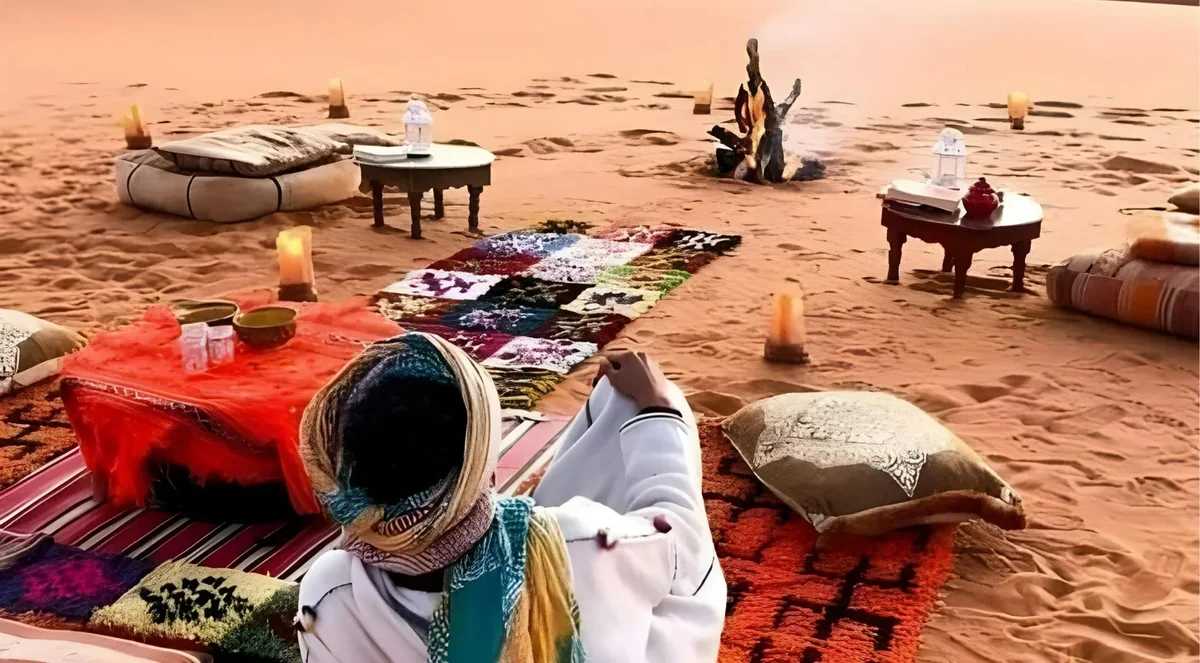
A permanent camp is the standard version. The Bedouin-style tents stay pitched all season, with mattresses or beds and blankets already laid out, a dining tent, dinner cooked on site and, at the better camps, flushing toilets and hot showers. Several tours from Djerba promise a private tent for your own party; others share tents within the group.
A bivouac is carried in and taken away again: tents or open sleeping in the dunes, a fire, dinner cooked on it, and no buildings, plumbing or electricity. The best three-day tours use one on the second night after a permanent camp on the first, such as the three-day Sahara tour with a camp and a bivouac ($417, rated 4.9 from 12 reviews).
Neither is the better night. If a hot shower after a long drive matters to you, stay in a fixed camp close to the road. If silence and distance are the point, the bivouac is the fuller version of the experience. Our desert camping tours page also covers the third option, a hotel night in Douz or Tozeur sold as “a night in the desert”.
What to check: whether the listing says camp, bivouac or hotel, and whether a “private tent” means your own tent or a shared one with your group.
Bathrooms, showers and electricity
At the fixed camps near Ksar Ghilane, Sabria and Douz, expect a shared toilet and shower block a short walk from the tents. Standards vary: the better camps have flushing toilets and hot water, others have basic facilities and water that is only warm in the evening. Guests on the Douz camel-trek camp mention the toilets and showers by name, which tells you to check before you book.
Electricity is limited almost everywhere. Many camps light the dining tent and paths with a generator or solar panels, and charging is often only possible there, if at all. Remote camps at Zmela and Tembaine usually have no power and no plumbing. Phone signal is patchy at the road-side camps and absent in the deep dunes.
What to check: whether toilets and showers are on site and shared or private, whether there is hot water, and whether you can charge a phone. A power bank and a head torch solve most of the rest.
What happens between sunset and sunrise
A typical evening runs like this. You reach the camp in the late afternoon, drop your bag and head up the nearest dune, or onto a camel, for sunset. Back at camp there is mint tea, and many camps show you mella, the flatbread baked directly in the sand under the embers. Dinner follows in the dining tent or around the fire: usually soup, salad, a main such as couscous or a slow-cooked stew, bread and dates. Then comes drumming or a folklore show at many camps, and a fire.
Then it gets cold. From November to March the temperature drops close to freezing after dark, however warm the afternoon was, and this is the thing that catches most people out. The camps provide blankets; they do not provide clothes. With no light pollution, the sky is the reason most people remember the night, and the Milky Way is visible on clear nights.
Every camp wakes you early for sunrise, before 6am in midsummer and after 7am in midwinter. Breakfast follows, then the drive or camel ride out. On the sunset-and-sunrise 4x4 tour from Djerba with a tent night ($144, rated 4.8 from 609 reviews), pickup is at about 11am, the afternoon includes a swim in the Ksar Ghilane spring, and you are back at your hotel late the following morning.
What to check: whether dinner and breakfast are included, whether the camel ride is timed for sunset and sunrise, and what time you are back on the second day.
What to pack for one night
Practical preparation matters more than specialist gear. Light layers, sun protection, comfortable closed shoes, water and a warm evening layer cover most normal tours. Pack one small bag for the night and leave the large suitcase at the hotel or in the vehicle.
Families and travellers with specific comfort needs should confirm the time in the vehicle, the camp bathrooms, any age rules for camel or quad rides and the exact route before booking. A child or anyone who sleeps cold needs more than the camp’s blankets from November to March.
What to check: whether the vehicle stays near the camp overnight (so you can leave things in it), and whether bedding includes a pillow and sheets or only blankets.
Ksar Ghilane, Douz/Sabria and Tembaine compared
Ksar Ghilane is the easiest overnight from Djerba and Zarzis, and the only one with a warm spring to swim in before dinner and again before breakfast. The camps are fixed and generally well equipped. The two-day 4x4 tour with a desert camp night ($48, rated 4.7 from 541 reviews) is the cheapest way to spend a night in the Tunisian Sahara from Djerba. Our Ksar Ghilane guide covers the spring and the Tisavar fort.
Douz and Sabria are the straightforward first desert night from Douz or the northern coast. From Douz itself, the overnight camp with dinner, sunset and sunrise by camel ($116, 4.5 from 73 reviews) picks you up at 3:30pm and has you back in town by about 9am or 10am, and the two-day camel trek with an overnight camp ($117, 4.9 from 13 reviews) spends longer in the saddle. From Tunis, Hammamet or Sousse, the 2-Day Sahara Express ($118, 4.7 from 1,337 reviews) sleeps at a tented camp at Sabria.
Tembaine is for travellers who have already had an easy desert night and want real distance from the road. It takes several hours each way over sand from Douz, the camp is a bivouac, and it only appears inside longer multi-day itineraries. Our desert camps guide compares Zmela and Tembaine in more detail.
What to check: total transfer time, whether the camp is fixed or a bivouac, and whether the route reaches the camp named in the title.
How long do you need?
One day can work from Djerba for Ksar Ghilane, but that is not a night in the desert. Two days is enough for an overnight introduction. Three days is better for a first full route that includes Tozeur as well as Douz, and a genuine Tembaine night needs three or four days. If Tozeur is on your route, our Tozeur desert guide covers the oases and the Mos Espa set on the other side of Chott el Jerid.
Best time to go
For most desert activities, October through April is the easiest season. November and March are especially comfortable for a mix of sightseeing, camping and outdoor activities. December to February nights are the coldest, close to freezing, so a fleece and warm socks are essential. July and August make the whole trip hard, not only the night, with afternoons above 40°C. Our best-time guide has the month-by-month detail.
Self-drive or organised tour?
Main towns and several headline destinations are road-accessible, but genuine dune tracks and remote camps should be handled with suitable vehicles and local expertise. Even where you can drive to the edge of the sand, the camp’s own vehicle or camel string usually covers the last stretch.
For a short two- or three-day trip, an organised route is often more efficient. Self-driving becomes more attractive when you have four or more days and want to control photography stops, meal times and nights in different bases. In that case, book the camp night directly with a camp or a local operator who meets you at the road.
What to pack
- Comfortable closed shoes
- Lightweight trousers and breathable tops
- Hat, sunglasses and sunscreen
- Scarf for wind and sand
- Water bottle
- Power bank
- Warm layer for desert evenings
- Small overnight bag if camping
- Swimwear and towel for Ksar Ghilane
- Head torch, ideally with a red-light mode
Frequently asked questions
Is a desert night worth adding to a first Tunisia Sahara trip?
Yes, if it fits your route and priorities. Sunset, a dark sky and sunrise in the dunes are the parts of a Sahara trip most visitors remember. The main mistake is trying to include every famous southern destination in too little time.
How many days should I allow for a Sahara overnight?
Allow two days for an overnight introduction from Djerba or the coast, and three or more for a broader circuit that adds Tozeur or a remote camp.
Do I need a 4x4 to reach a desert camp?
Not for every main road or town. Use local 4x4 transport for genuine desert tracks, remote camps and off-road excursions; most tours include this last stretch.
Is one desert night enough?
For most first-time visitors, yes. One night gives you sunset, darkness and sunrise, which are the main reasons to stay.
What is the best season for camping in the Tunisian Sahara?
October through April is generally the most comfortable period, with November and March the easiest months. Bring warm layers from November to March, when nights drop close to freezing.
Final planning advice
Build the itinerary around the experience you care about most. If that is dunes and camping, protect the evening in the desert. If it is oases and Star Wars, give Tozeur or Matmata enough time. If it is convenience, choose Ksar Ghilane from Djerba instead of forcing a cross-country route. A slightly shorter list of stops usually makes a better Sahara trip.
Ready to book? Compare desert camping tours with live prices, or see our desert camps guide to choose between the camps.
See the Sahara From Your Hotel Door
Hotel pickup, a 4x4 across the Dahar plateau, the hot spring at Ksar Ghilane, and lunch — rated 4.8/5 by 1,834 guests. Free cancellation up to 24 hours before.
Check Availability & Book