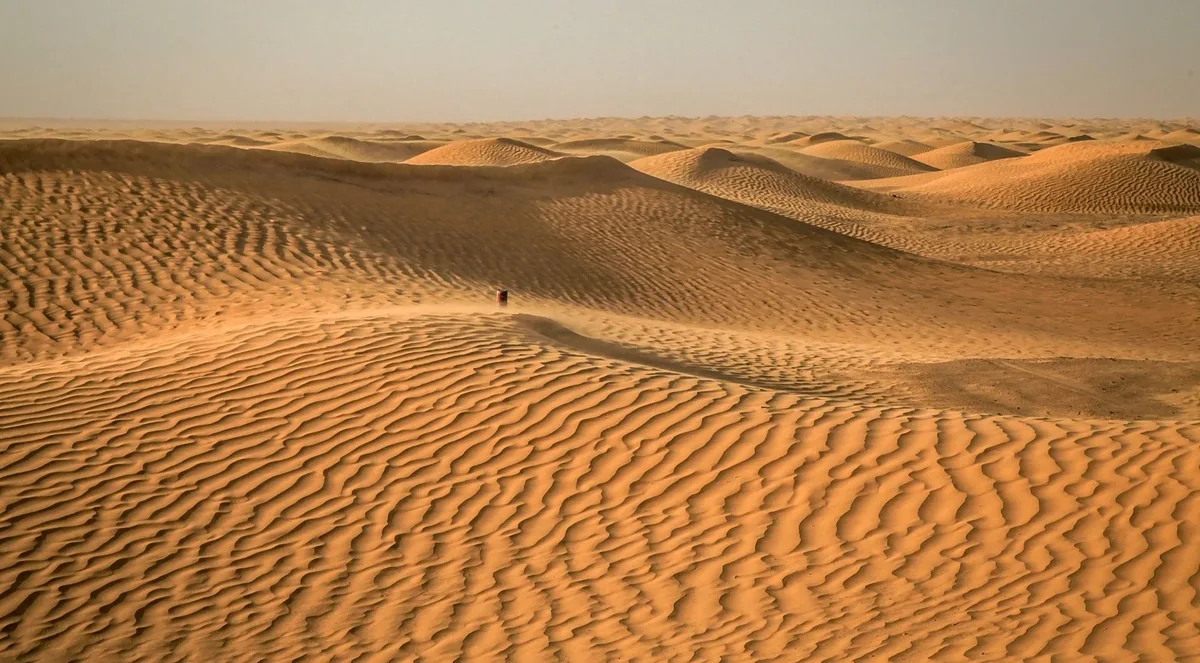
Sahara Sunset in Tunisia
Where to watch the sun go down over the Tunisian Sahara, what time it sets through the year, and which tours keep you on the dunes at the right hour, from Ksar Ghilane and Douz to Tembaine and Ong Jemel.
The sun sets over the Tunisian Sahara at about 5:20pm in December and about 7:35pm in late June. Most day trips from Djerba are already on the road home by then, so the reliable ways to watch it go down over the dunes are a night in a desert camp, a sunset camel ride from Douz, or one of the few day tours that are timed for the evening.
Check Availability
Quick take
Pick one place for sunset and give it the whole evening. The trips people remember pair one desert sunset with a few stops that complement it, and leave time for a proper dinner and an unhurried morning. Ksar Ghilane is the easiest sunset from Djerba, Douz has dunes at the end of town, and the remote camps at Tembaine or the rock at Ong Jemel near Tozeur suit a longer route.
Key planning points
- Ksar Ghilane for an oasis-and-dunes sunset. A swim in the warm spring, then the dunes behind the camps.
- Douz for sunset camel rides. The sand starts at the edge of town, so a ride out needs no long transfer.
- Sabria and Zaafrane for camp sunsets. Where many two-day tours from the coast spend their desert night.
- Tembaine for remote evening light. Several hours from Douz over sand, with nothing man-made on the horizon.
- Ong Jemel from Tozeur. The camel-shaped rock and the Mos Espa film set in the late afternoon.
- Sunset tour vs overnight camp. A night adds the dark sky and sunrise; a day tour timed for the evening saves a night.
Ksar Ghilane for an oasis-and-dunes sunset
Ksar Ghilane is the southernmost oasis in Tunisia: a palm grove and a spring-fed pool on the edge of the Grand Erg Oriental. The camps sit around the oasis and the first real dunes start a short walk behind them, so on an overnight you can swim in the warm pool in the late afternoon and still climb a dune before the light goes.
The catch is the timetable. The most-booked day trips from Djerba, such as the Ksar Ghilane and Tataouine 4x4 day trip ($69, rated 4.8 from 1,834 reviews), leave the island before dawn and spend the middle of the day at the oasis, so you see the dunes in strong midday light and drive back in the afternoon. For the evening light you need the night. The sunset-and-sunrise 4x4 tour from Djerba with a tent night ($144, 4.8 from 609 reviews) is built around it: pickup is at about 11am, with the Chahbania salt lake and Ksar Hadada on the way down, time in the spring, sunset at the camp and an early call for sunrise. A camel ride is an optional extra on that tour. The two-day 4x4 tour with a desert camp night ($48, 4.7 from 541 reviews) is the cheaper version, with camel and quad rides available at the oasis.
Before booking, check the exact camp location, the bathrooms, the bedding, which meals are included and how you reach the camp. If you want a camel at sunset, book that one ride; a camel, a quad and a 4x4 session in the same hour leaves no time to watch the light. Our Ksar Ghilane guide covers the spring and the Roman fort.
What to check: what time you reach the oasis, whether the camp is in the dunes or beside the pool, whether a camel ride is included or extra, and whether this night repeats another camp night already on your itinerary.
Douz for sunset camel rides
Douz sits on the northern edge of the Grand Erg Oriental, and the sand begins where the town ends. That makes it the simplest place in Tunisia to ride a camel into the dunes for sunset and be back in town for dinner.
GetYourGuide has no stand-alone sunset ride here. On Viator, the sunset or sunrise camel ride from Douz ($65, 4.7 from 10 reviews) is a three-hour private outing with hotel pickup in Douz, a climb to the top of a dune for the view, and a stop in the palm groves on the way back. The GetYourGuide listings in Douz are overnights that use the sunset as the ride out. The two-day camel trek with an overnight camp ($117, 4.9 from 13 reviews) picks you up at 3:30pm and has you back in town by 9am or 10am, and the desert camp with a sunset and sunrise camel trek ($116, 4.7 from 7 reviews) starts an hour later, at around 4:30pm.
From November to January, a 4:30pm start leaves about an hour of light, sometimes less, so ask whether the pickup moves earlier in winter. Our camel tours guide compares short rides with real treks, and the Douz desert tours page covers the quad and 4x4 options from the same town.
What to check: the pickup time against that day’s sunset, how long you are actually on the camel, whether the ride is private or shared, and whether you need cash for a tip.
Sabria and Zaafrane for camp sunsets
Zaafrane and Sabria are small desert villages west and south-west of Douz, on the edge of the same sand sea, and the camps around them are where many tours from the northern coast spend their desert night. Sunset here is the reward for a long drive.
The 2-Day Sahara Express from Tunis, Hammamet and Sousse ($118, rated 4.7 from 1,337 reviews) gives you about two hours on the dunes at its Sabria camp around sunset, followed by sand bread baked in the embers, a folklore show, dinner and the Milky Way. The two-day desert tour with a tent night from the same three towns ($174, 4.6 from 145 reviews) sleeps at a camp near Douz, with free time for the sunset and an optional camel ride.
The first day of these trips starts at 6am and runs through El Jem and Matmata, so the camp is reached in the late afternoon. In December and January that can be close to sunset, and a slow stretch of road can cost you the light. The second day crosses Chott el Jerid towards Tozeur.
What to check: the scheduled arrival time at camp, whether the camp sits in the dunes or on the edge of a village, and whether the sunset camel ride is included or paid on the spot.
Tembaine for remote evening light
Tembaine is a lone rocky hill deep in the Grand Erg Oriental, south of Douz, with a few fixed camps and bivouac sites around it. There is no road and no phone signal, and the evening light falls on dunes with nothing built in sight. It is the sunset for travellers who have already had an easy desert night and want real distance.
Getting there takes several hours over sand from Douz by 4x4, with an experienced desert driver. Some itineraries visit it as a full day’s 4x4 outing from Douz, but most travellers who sleep there do so on a three- or four-day route from Douz or Ksar Ghilane. Neither GetYourGuide nor Viator currently has a reviewed tour that reaches it, so book through a Douz operator who runs desert routes. Our desert camps guide compares Tembaine with Zmela and the easier camps.
What to check: that the route really reaches Tembaine and not only “the dunes south of Douz”, whether the group travels with a second vehicle and a satellite phone, and whether the night is in a fixed camp or a bivouac.
Ong Jemel from Tozeur
Ong Jemel, “the camel’s neck”, is a rock outcrop north-west of Tozeur that looks like its name from one side. The Mos Espa town set from The Phantom Menace still stands among the dunes nearby, and late afternoon is the time to be there: the sand turns gold, the set casts long shadows, and the coaches from the coast have usually left. Sunset at Tozeur is a few minutes later than at Douz.
The appeal of this corner is variety. Palm groves, springs, canyon scenery at the mountain oases and the salt flat of Chott el Jerid all sit within a short drive of Tozeur, so use the town as a base, walk the oases in the morning and keep the late afternoon for Ong Jemel. On Viator, the half-day Ong Jemel and Mos Espa excursion from Tozeur ($80, 4.4 from 9 reviews) lasts three to five hours with hotel pickup; ask for an afternoon departure. On GetYourGuide, the private full day with the Mos Espa set and the mountain oases ($100, 5.0 from 4 reviews) covers both in one day. Our Tozeur desert guide has the full plan.
What to check: whether the tour stops at Mos Espa itself or only at the rock, what time it leaves Tozeur, and whether the driver will wait for sunset.
Sunset tour vs overnight camp
A night in the desert gives you three things a day trip cannot: sunset, a sky with no light pollution, and sunrise. For most first-time visitors that is the better use of a day, and our overnight camping guide covers the camps, the food and the cold.
If you cannot spare a night, a few day tours from Djerba are timed for the evening. The Star Wars and sunset tour in the Tataouine desert ($57, 4.4 from 92 reviews) visits the film locations at Ksar Hadada and Ouled Soltane and ends on the dunes near Chahbania for sunset. The Sahara Dream 4x4 day with Matmata and Tataouine ($83, 4.8 from 28 reviews) is a 12-hour private day that includes the Ksar Ghilane spring, lunch and dinner, and is sold with sunset on the sand. Both bring you back to your hotel well after dark.
What to check: the return time to your hotel, how long you spend on the dunes at sunset, and whether dinner is included or you will be hungry on the drive home.
How long do you need?
One day can work from Djerba for Ksar Ghilane, but on most day trips you will not see sunset there. Two days is enough for an overnight introduction with one sunset and one sunrise. Three days is better for a first full route that includes Tozeur as well as Douz, which gives you two different sunsets, one over the dunes and one at Ong Jemel.
Best time to go
For most desert activities, October through April is the easiest season. November and March are especially comfortable for a mix of sightseeing, camping and outdoor activities. The evening itself changes through the year: sunset comes early in winter and the temperature falls fast once the sun has gone, while in summer the light lasts later but the afternoons are above 40°C.
| Month (mid-month) | Sunset in Douz, about | Sunrise in Douz, about |
|---|---|---|
| January | 5:35pm | 7:30am |
| March | 6:30pm | 6:35am |
| May | 7:15pm | 5:25am |
| July | 7:35pm | 5:25am |
| September | 6:30pm | 6:05am |
| October | 5:50pm | 6:25am |
| November | 5:25pm | 6:55am |
| December | 5:20pm | 7:20am |
Tunisia stays on the same clock all year, with no summer time. Tozeur is a few minutes later and Ksar Ghilane a few minutes earlier than Douz. Our best-time guide has the month-by-month weather.
Self-drive or organised tour?
Main towns and several headline destinations are road-accessible, but genuine dune tracks and remote camps should be handled with suitable vehicles and local expertise. Sunset adds one more reason: the drive back from the dunes happens in the dark, and unlit desert tracks are no place to find your way for the first time.
For a short two- or three-day trip, an organised route is often more efficient. Self-driving becomes more attractive when you have four or more days and want to control photography stops, meal times and nights in different bases. In that case, sleep at the camp or in the town nearest the dunes, so the sunset does not end with a long night drive.
What to pack
- Comfortable closed shoes
- Lightweight trousers and breathable tops
- Hat, sunglasses and sunscreen
- Scarf for wind and sand
- Water bottle
- Power bank
- Warm layer for desert evenings
- Small overnight bag if camping
- Swimwear and towel for Ksar Ghilane
- Head torch for the walk back from the dunes after sunset
Frequently asked questions
Is a Sahara sunset worth adding to a first Tunisia trip?
Yes, if it fits your route and priorities. The dunes look flat in the middle of the day and very different in the last hour of light. The main mistake is trying to include every famous southern destination in too little time and seeing all of them at noon.
What time is sunset in the Tunisian Sahara?
In Douz, about 5:20pm in December, 6:30pm in March and September, and 7:35pm in late June and July. Tunisia does not change its clocks in summer, and sunset at Ksar Ghilane and Tozeur is within a few minutes of Douz.
How many days should I allow for a desert sunset?
Allow two days for an overnight introduction from Djerba or the coast, which gives you one sunset and one sunrise, and three or more for a broader circuit with Tozeur and Ong Jemel.
Do I need a 4x4?
Not for every main road or town. Use local 4x4 transport for genuine desert tracks, remote camps and off-road excursions, and do not plan to drive an unfamiliar desert track back after dark.
Is one desert night enough?
For most first-time visitors, yes. One night gives you sunset, darkness and sunrise, which are the main reasons to stay.
What is the best season for a Sahara sunset trip?
October through April is generally the most comfortable period, with November and March the easiest months. Bring a warm layer from November to March, because the temperature drops quickly once the sun has set.
Final planning advice
Plan the trip around the experience you care about most. If that is dunes and camping, protect the evening in the desert. If it is oases and Star Wars, give Tozeur or Matmata enough time, and keep the late afternoon for Ong Jemel. If it is convenience, choose an overnight at Ksar Ghilane from Djerba instead of forcing a cross-country route. A slightly shorter list of stops usually makes a better Sahara trip.
Ready to book? Compare desert camping tours with live prices, or see our Ksar Ghilane tours for the oasis day trips and overnights.
See the Sahara From Your Hotel Door
Hotel pickup, a 4x4 across the Dahar plateau, the hot spring at Ksar Ghilane, and lunch — rated 4.8/5 by 1,834 guests. Free cancellation up to 24 hours before.
Check Availability & Book