Tozeur Desert Guide
How to use Tozeur as a base for Chebika, Tamerza and Midès, Nefta, Ong Jemel and the Mos Espa set, and the Chott el Jerid crossing to Douz: nights, day trips, seasons and tours.
Tozeur sits on the north-western shore of Chott el Jerid, with three mountain oases in the hills behind it, the palm groves of Nefta 24km to the west and the Mos Espa film set out on the sand beyond. Few towns in southern Tunisia have that much within an hour’s drive, which is why Tozeur works best as a base for two or three nights, not as a lunch stop on a coach loop.
Check Availability
Quick take
Plan a Tozeur trip around two or three things you care about. Trying to collect every famous name in the south is the usual mistake. The trips that work best combine a few landscapes that complement each other, and still leave time for sunset, a proper meal and at least one unhurried stop.
Key planning points
- How many nights to spend in Tozeur. Two nights covers the mountain oases on one day and Nefta, Ong Jemel and Mos Espa on the other.
- The mountain-oasis circuit. Chebika, Tamerza and Midès fit into one half-day by 4x4.
- Ong Jemel and Mos Espa. The film set and the rock formation beside it are about 40km from Tozeur, and best at the end of the afternoon.
- Nefta and the palm-oasis landscape. A quieter oasis town 24km west, with its palm-filled hollow, the Corbeille.
- Chott el Jerid on the road to Douz. The salt pan takes about an hour to cross; Douz is roughly two hours away.
- Tozeur vs Douz as a Sahara base. Tozeur for oases and film sets, Douz for dunes and camps.
How many nights to spend in Tozeur
Two nights is the right number for most first visits. The first full day goes to the mountain oases, a half-day by 4x4 that leaves the afternoon free for the palm groves and the old quarter of Ouled el Hadef, where the houses are faced in patterned yellow brick. The second day goes west: Nefta in the morning, then Ong Jemel and the Mos Espa set timed for the late-afternoon light.
One night works if you arrive on a tour from the coast and only want the mountain oases. It does not leave time to walk in the palm groves, and the oases are at their best on foot. A row of roadside photo stops misses most of them. A third night suits anyone adding a quad or buggy session on the dunes, or a day across Chott el Jerid to Douz and back.
Tozeur also has an airport, Tozeur–Nefta, with flights from Tunis and some direct flights from Paris, which makes it the one desert town you can reach without a long drive from the coast. From Djerba, two-day tours such as the two-day tour to Tozeur, the mountain oases and Matmata ($150, rated 4.8 from 25 reviews) spend a night here and cover the oases and Mos Espa in between the drives.
What to check: how long the route spends in Tozeur, what transport is included between the sights, how much time you get on site at each stop, which extras cost more, and whether any stop repeats something already in your itinerary.
The mountain-oasis circuit
Chebika, Tamerza and Midès sit in the hills north-west of Tozeur, close to the Algerian border, and each is different (our guide to Chebika, Tamerza and Midès takes them one by one). Chebika is a spring in a cleft of rock, with a short walk up a gorge to a small waterfall. Tamerza has the larger waterfall and the biggest of the old villages abandoned after the floods of 1969. Midès stands on the lip of a deep canyon, and the view down into it is what most people remember.
The circuit is about 50 minutes’ drive out to Chebika, then 20 minutes to Tamerza and 15 to Midès, with an hour back to Tozeur. The private 4x4 tour to Chebika, Tamerza and Midès does all three in about five hours for $55 per person, with a local guide for the Chebika walk, and is rated 4.9 from 27 reviews. Start early: there is little shade on the canyon paths, and by late morning the heat comes off the rock as well as the sky.
Our desert oases guide has more on each of the three, including which is the easiest walk and which needs care with children.
What to check: whether each oasis gets a proper stop with time to walk, whether a guide is included at Chebika, and whether the waterfalls will be running in the month you travel.
Ong Jemel and Mos Espa
Ong Jemel, “the camel’s neck”, is a rock outcrop north-west of Tozeur that looks like its name from one side. Anthony Minghella filmed scenes of The English Patient in the surrounding desert, and George Lucas built the Mos Espa town set close by for The Phantom Menace in 1997. The set was never taken down, and it is still standing among the dunes about 40km from Tozeur.
A paved road from Nefta now runs almost to the set, with a short stretch of packed sand at the end, so an ordinary car can reach Mos Espa. The rock and the open dunes around it are where the 4x4s and quads take over. Late afternoon is the best time to be there: the sand turns gold, the set casts long shadows, and the tour buses from the coast have usually left.
On GetYourGuide, the private full day with the Mos Espa set and the three mountain oases covers everything from Tozeur for $100, though it has only four reviews so far (all 5.0). On Viator, the half-day Ong Jemel and Mos Espa excursion from Tozeur is the dedicated option (4.4 from 9 reviews), and the full-day Tamerza, Chebika, Midès and Star Wars tour pairs the set with the oases ($130, 4.5 from 27 reviews). Our Mos Espa tours page and Star Wars filming locations guide cover the set, the Lars homestead dome and the other locations in full.
What to check: whether the tour stops at Mos Espa itself or only at Ong Jemel, whether it is timed for sunset, and whether the white Lars homestead dome near Nefta is included if you want it.
Nefta and the palm-oasis landscape
Nefta is 24km west of Tozeur, close to the Algerian border, and it gets a fraction of Tozeur’s visitors. Its best-known sight is the Corbeille, a deep hollow on the edge of town filled with palms and fed by springs, best seen from the cafés on the rim above it. The old quarters around it are known for their many mosques and zaouias, the shrines of local Sufi saints.
Nefta also sits on the road to Ong Jemel and Mos Espa, so the natural plan is a morning in the town and the palm grove, lunch, and then the film set and the dunes in the late afternoon. If you have a third day, a slower morning in Nefta is a good way to see an oasis town without Tozeur’s tour traffic.
What to check: whether a Nefta stop means a walk into the palm grove or only a photograph from the rim, and whether your day trip to Mos Espa passes through Nefta anyway.
Chott el Jerid on the road to Douz
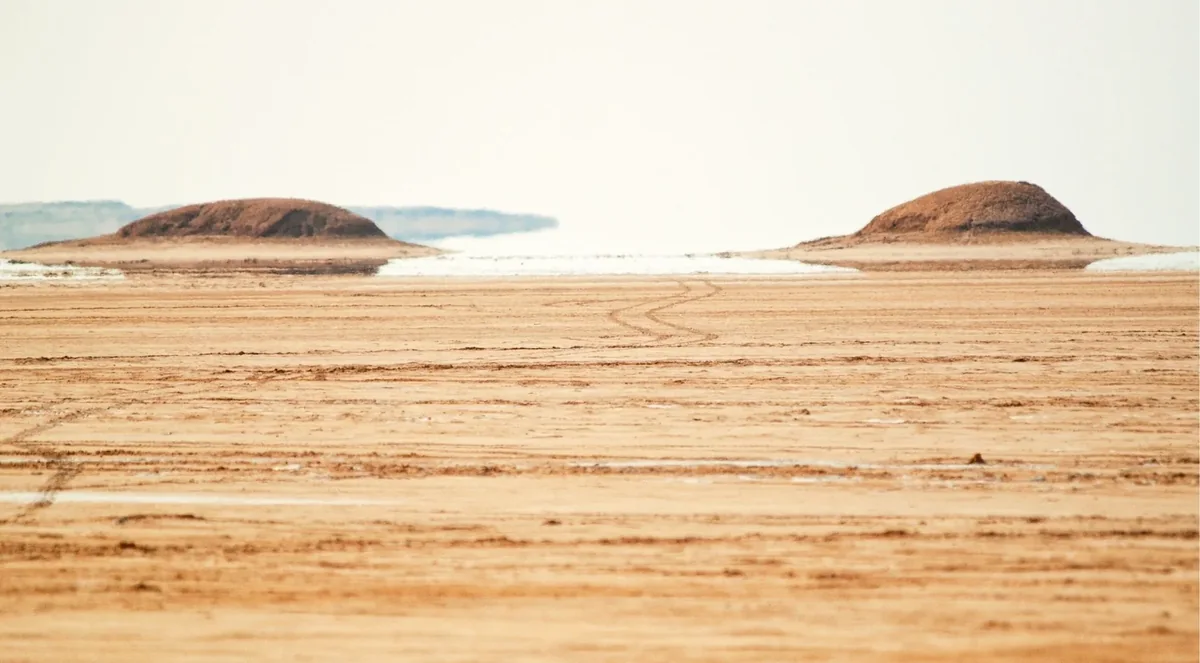
Chott el Jerid is the largest salt pan in the Sahara (our Chott el Jerid guide covers the crossing, the stops and the light in detail). A raised road crosses it from Tozeur towards Kebili and Douz, dead straight for most of the way, with white and rust-coloured crust on both sides. The crossing takes about an hour, and the full drive from Tozeur to Douz is about 122km, roughly two hours. By mid-morning the heat over the salt produces mirages; after rain, a thin sheet of water can lie on the surface and reflect the sky.
Timing matters here more than anywhere else on the trip. The chott looks flat and washed out at midday and far better in the low light of early morning or late afternoon. Most tours make one photo stop on the causeway, where vendors sell salt-crystal “desert roses”. Do not walk far out onto the crust: it can be soft underneath. If the crossing leads on to a desert night near Douz, check the exact camp location, the bathroom setup, the bedding, which meals are included and how you get from the road to the camp. For activities, pick the one you want, whether a camel, a quad or a 4x4, not all three in the same hour.
What to check: whether the crossing is a through-drive on the way to Douz or a return trip from Tozeur, and when in the day your tour reaches it.
Tozeur vs Douz as a Sahara base
Tozeur is the base for oases, canyons and film sets. It has the airport, the mountain oases behind it and Mos Espa within an hour. What it does not have is dunes on its doorstep: the open sand starts out past Nefta, and a night in a desert camp means a transfer.
Douz, about two hours east across the chott, is the base for the sand. The dunes of the Grand Erg Oriental begin at the edge of town, so camel treks start from the edge of town and the tented camps are close. It is the better choice if a camel ride at sunset and a night in a camp are the reason for the trip; see our Douz desert tours, the Douz Sahara guide and overnight desert camping guide.
If you have three or more days, use both: two nights in Tozeur for the oases and Mos Espa, then cross the chott for a camp night near Douz. Our Djerba vs Tozeur guide compares the south-west with the Djerba side of the desert.
What to check: where the desert camp on a “Tozeur” itinerary is, since many sit near Douz, two hours away.
How long do you need?
From Djerba, one day works for Ksar Ghilane, but Tozeur is too far for a day trip from the coast. Two days is enough for an overnight introduction that includes Tozeur, and three days is better for a first route that covers Tozeur as well as Douz. Based in Tozeur itself, a half-day covers the mountain oases and another half-day covers Mos Espa.
Best time to go
For most desert activities, October through April is the easiest season (our guide to the best time to visit the Tunisian Sahara has the monthly figures). November and March are especially comfortable for a mix of sightseeing, camping and outdoor activities. January days in Tozeur sit around 17–20°C, with nights close to freezing, and winter rain feeds the Chebika and Tamerza waterfalls. July and August are hard going: 42°C is a normal Tozeur afternoon, and the canyon walks are best done at first light. Our best-time guide goes month by month.
Self-drive or organised tour?
Tozeur, Nefta, the mountain oases and the road to Mos Espa are all on tarmac, and this is the easiest corner of the Tunisian Sahara to explore with a hire car. Genuine dune tracks, the open sand around Ong Jemel and remote camps should be left to suitable vehicles and local drivers who know them.
For a short two- or three-day trip, an organised route is often more efficient. Self-driving becomes more attractive when you have four or more days and want to control photography stops, meal times and nights in different bases. For time on the dunes from Tozeur, the one-hour quad ride ($44, 5.0 from 8 reviews) and the two-hour quad ride ($60, 4.5 from 21 reviews) both start in town.
What to pack
- Comfortable closed shoes with grip for the Chebika and Midès paths
- Lightweight trousers and breathable tops
- Hat, sunglasses and sunscreen
- Scarf for wind and sand
- Water bottle
- Power bank
- Warm layer for desert evenings
- Small overnight bag if camping
- Swimwear and towel if your route also takes in Ksar Ghilane
Frequently asked questions
Is Tozeur worth adding to a first Tunisia Sahara trip?
Yes, if it fits your route and your priorities: Tozeur is the base for the mountain oases, Nefta and the Mos Espa set. The main mistake is trying to include every famous southern destination in too little time.
How many days should I allow for Tozeur?
Two nights covers the mountain oases on one day and Nefta, Ong Jemel and Mos Espa on the other. Allow two days for an overnight introduction from the coast, and three or more for a circuit that adds Douz.
Do I need a 4x4 around Tozeur?
Not for the main roads, the mountain oases or the paved road to the Mos Espa set. Use local 4x4 transport for genuine desert tracks, the dunes around Ong Jemel, remote camps and off-road excursions.
Is one desert night enough?
For most first-time visitors, yes. One night gives you sunset, darkness and sunrise, which are the main reasons to stay. From Tozeur, most camp nights are near Douz, across Chott el Jerid.
What is the best season for Tozeur?
October through April is generally the most comfortable period for outdoor Sahara activities, with November and March the easiest months for walking and camping.
Final planning advice
Build the itinerary around the experience you care about most. If that is dunes and camping, protect the evening in the desert. If it is oases and Star Wars, give Tozeur or Matmata enough time. If it is convenience, choose Ksar Ghilane from Djerba instead of forcing a cross-country route. A slightly shorter list of stops usually makes a better Sahara trip.
Ready to book? Compare Tozeur desert tours with live prices, or see the decision guide to compare every route on the site.
See the Sahara From Your Hotel Door
Hotel pickup, a 4x4 across the Dahar plateau, the hot spring at Ksar Ghilane, and lunch — rated 4.8/5 by 1,834 guests. Free cancellation up to 24 hours before.
Check Availability & Book