What to Expect on a Tunisia Sahara Tour
An honest walkthrough of a Tunisian desert tour — pickup times, how much of it is driving, what a camp night is like, what to pack, and the things reviewers wish they had known.
The single most useful thing to know before a Tunisian desert tour is how it is shaped. It is not a day in the dunes with some transfer attached. It is a long drive through genuinely interesting country that ends in sand, and every complaint in the three-star reviews comes down to someone expecting the first thing and getting the second.
Check Availability
The pickup is earlier than you think
From Djerba and Zarzis, pickups run between 6am and 7am. From Hammamet, Sousse and Tunis, the two-day tours leave around 5am.
You are collected from your accommodation on almost every tour in the catalogue. The exception worth knowing about is central Tunis — several operators ask guests in the medina, Carthage, La Marsa, Sidi Bou Said or Gammarth to meet in front of the Hotel El Hana International instead, because those streets do not take a coach at dawn.
Ask your hotel the evening before for the exact window. Many operators confirm it by WhatsApp; others rely on reception knowing.
How much of the day is actually driving
This is the honest arithmetic, taken from the operators’ own itineraries.
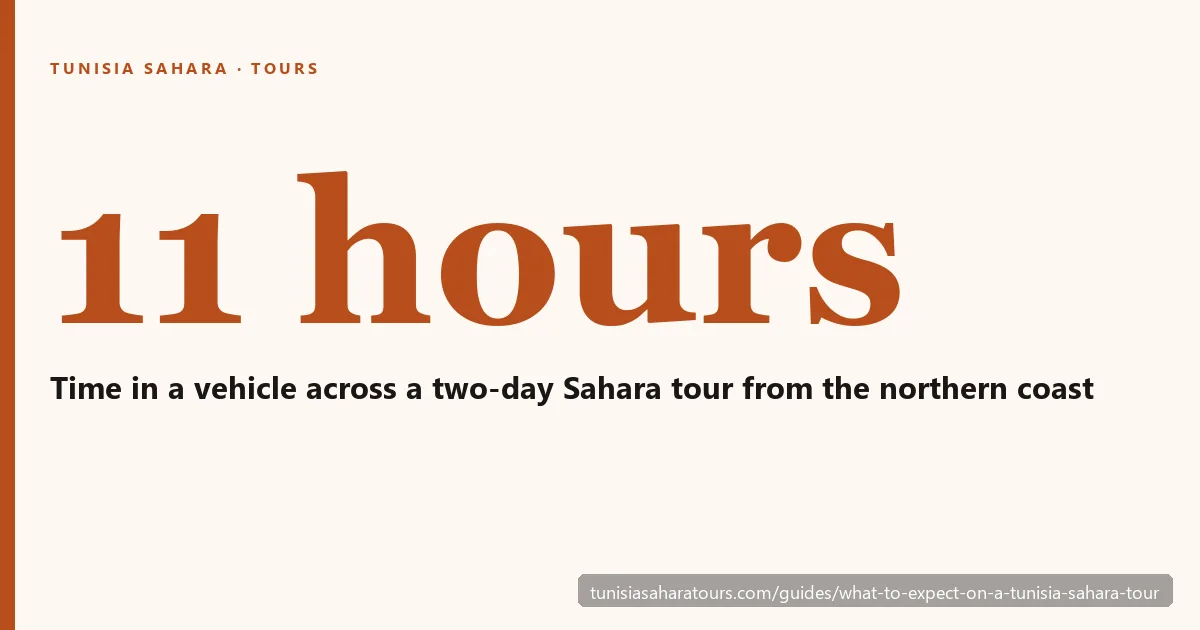
On the two-day tour from the northern coast: about two hours to El Jem, forty minutes there, three hours to Matmata, an hour and a half of lunch and visits, three hours to the camp. Day two adds a little over three and a half hours of transfer after lunch. Eleven hours in a vehicle across the two days, give or take.
On a day trip from Djerba: four hours out, three at the oasis, four back. Roughly eight of the ten to twelve hours are on the road.
Neither is a scandal — it is how far the desert is. But it does mean the seat matters. Several reviewers who gave five stars still name the back row on a twelve-hour jeep day as the uncomfortable one, so if there is an opportunity to ask, ask.
What the stops are like
El Jem gets about forty minutes with a guide. It is a third-century Roman amphitheatre that is still almost entirely standing, and forty minutes is enough rather than generous.
Matmata is 30 to 60 minutes. You see a troglodyte house — a pit dug into the ground with rooms tunnelled out of its walls — and usually the Sidi Driss hotel, whose sunken courtyard was the Lars homestead interior in A New Hope. Most tours include tea with a family in their own underground home, with bread, honey and olive oil. That visit runs on tips.
Ksar Ghilane is the long one: up to three hours. The spring-fed pool is warm, open air and swimmable. Camel and quad rides are offered here and are almost always extra.
Chott el Jerid is an hour of crossing a salt pan that turns to mirage. There is usually one photo stop in the middle of it.
The camp night
If your tour includes one, this is what actually happens. You arrive in the late afternoon and watch the sun go down over the dunes. Dinner is cooked on site, with flatbread baked directly in the embers. There is tea, usually drumming or a folklore show, and then a fire.
The tents are already pitched, with mattresses and blankets. The better camps have flushing toilets and hot showers — guests on the Douz camel-trek camp mention them specifically, which tells you it is worth checking rather than assuming.
Then it gets cold. From November to March the temperature drops close to freezing after dark whatever the afternoon did. This is the most common piece of unpreparedness on these tours.
And the sky is the reason people write the reviews. There is no light pollution out there at all.
What to pack
A small overnight bag, not a suitcase — your case stays at the hotel you return to.
Warm layers for the desert night: a fleece, long trousers and socks between November and March. Sunglasses, a sun hat and sunscreen year round. Comfortable shoes with grip if Chenini is on your itinerary; the climb to its old mosque is steep and uneven. A swimsuit and towel if Ksar Ghilane is. A scarf or shesh for the sand, which most camps also sell. A torch. Cash in dinars for drinks, tips and the optional rides.
What is not included
Drinks are almost never included, and neither are tips. Entry fees to archaeological sites and museums are excluded on several itineraries — worth reading, because on a $57 day trip that gap is worth more than the difference between two fares. Camel and quad rides at the oasis are extra. Solo travellers on some two-day tours pay a single supplement — €35 on one of the best-known ones.
Who should think twice
Several operators state plainly that their desert legs are not recommended for people with back problems or limited mobility, and at least one asks pregnant travellers not to book. The tracks are corrugated and the days are long. If that applies to someone in your party, the coach-based two-day tours reach most of the same landmarks on sealed roads.
Frequently asked questions
How long is a Tunisia desert tour day?
Ten to twelve hours for a day trip from Djerba, with a 6am or 7am pickup. Two-day tours from the northern coast start around 5am on day one and return in the evening of day two.
How much of a Sahara tour is spent driving?
On the two-day northern tours, roughly eleven hours across two days. On a Djerba day trip, about eight of the ten to twelve hours. The operator of the most-reviewed two-day tour says so in its own listing rather than leaving you to discover it.
What is a night in a desert camp like?
Fixed Bedouin tents with mattresses and blankets, dinner cooked on site with flatbread baked in the fire, a fire and usually music, and a sky with no light pollution. The better camps have toilets and showers. It gets close to freezing between November and March.
Do I need to bring my own bedding?
No. The camps provide mattresses and blankets. Bring warm clothes to sleep in during the cooler months rather than extra bedding.
Are meals included?
Lunch is included on nearly every day tour, and dinner and breakfast on the overnight ones. Drinks are not. Vegetarian and other dietary requirements are usually workable but should be flagged to the operator when you book, not on the morning.
Will there be a toilet stop?
Yes — the drives are broken by stops at cafés and service areas, and the main sites have facilities. Between stops there is nothing, which is the normal desert answer.
Ready to choose? The decision guide narrows 116 listings down to a shortlist, or browse every tour with live prices.
See the Sahara From Your Hotel Door
Hotel pickup, a 4x4 across the Dahar plateau, the hot spring at Ksar Ghilane, and lunch — rated 4.8/5 by 1,671 guests. Free cancellation up to 24 hours before.
Check Availability & Book